
Can ChatGPT Build a Website? An Honest 2026 Answer
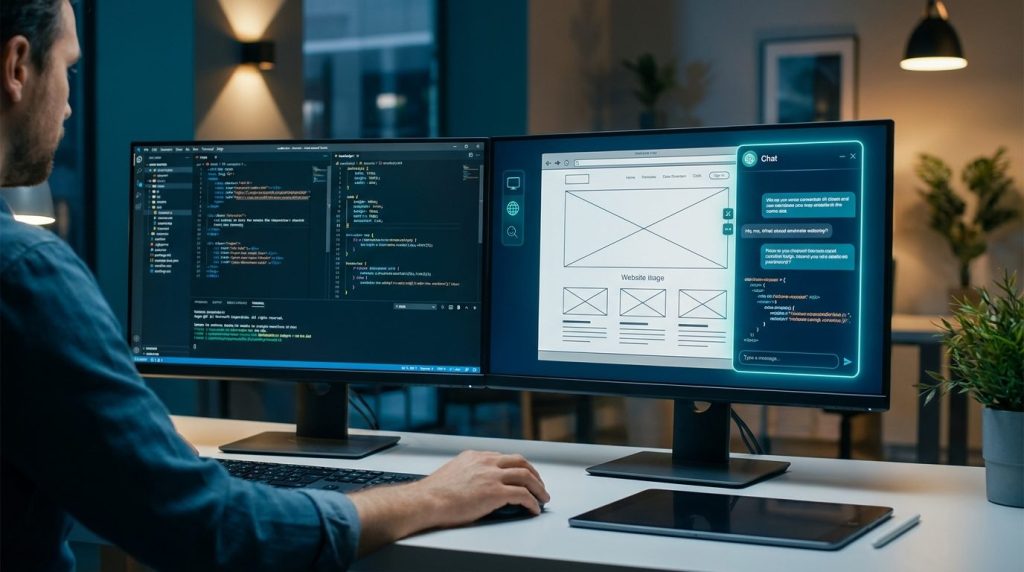
Can ChatGPT build a website? Yes and no, and the gap between the two is where a lot of people get stuck. ChatGPT can write the code, the copy, and the structure of a website. What it can’t do is host it, connect a domain, keep it secure, or fix it when it breaks. It’s a brilliant assistant and a poor webmaster.
Here’s an honest look at what ChatGPT can actually do for a website in 2026, where it falls short, and what you still need to end up with a site that works and keeps working.
What ChatGPT can do for a website
Quite a lot, and it’s genuinely useful:
- Write code. It can produce HTML, CSS, and JavaScript for pages and components, and generate WordPress snippets or theme code.
- Write content. Headlines, page copy, product descriptions, and meta descriptions, though it needs your direction to sound like you.
- Plan structure. Suggest a sitemap, a page layout, and what sections a given page should have.
- Debug. Paste in an error or a broken snippet and it can often spot the problem.
If you can code a little, ChatGPT is a strong accelerator. If you can’t, it’s where the trouble starts.
What ChatGPT can’t do
This is the part the excited headlines skip. ChatGPT gives you code and words. A live website needs much more:
- Hosting and deployment. ChatGPT can’t put your site online. You still need hosting, and you need to get the files there.
- A domain and SSL. Buying your address and securing the site are separate steps it can’t do for you.
- Real visual design. It works in text. It doesn’t see your brand or judge whether the result actually looks good.
- Testing. It can’t open your site on a phone, click every link, and check the checkout works.
- Maintenance. It won’t update plugins, patch security holes, take backups, or be there when the site breaks at 5pm on a Friday.
None of that is a knock on the tool. It’s just not what a chatbot does.
“Can ChatGPT build me a website” in practice
Here’s how it usually goes. You ask ChatGPT to build a website, and it gives you a block of code. Now you’re holding HTML you have to host somewhere, connect to a domain, and maintain. For a developer, that’s a fast start. For a non-technical business owner, that’s exactly the wall they were hoping to avoid.
The more realistic use for most people is ChatGPT plus a platform: use it to draft your content and plan your pages, then build on WordPress or a site builder that handles the hosting and technical side for you.
ChatGPT vs AI website builders
Worth clearing up a common mix-up. ChatGPT is a chatbot that produces code and text. AI website builders, like the ones built into Wix and similar tools, actually generate and host a working site for you from a few questions. If your goal is a live site with the least effort, an AI site builder gets you there more directly than ChatGPT. If your goal is control over the code, ChatGPT plus your own hosting gives you that.
Where AI genuinely helps
Used well, AI takes real work off your plate: drafting first-pass copy, generating boilerplate code, explaining an error, suggesting a layout. It speeds up people who already know what they’re doing, and it lowers the barrier for people willing to learn. What it doesn’t do is remove the need for the unglamorous parts that keep a site alive.
A note on “build a website in minutes” claims
You’ll see a lot of content promising a full website from one AI prompt in minutes. You can get something on screen that fast. Getting something that loads reliably, looks right on a phone, ranks, converts, and doesn’t break next month is a different bar. The minutes claim is true for the demo and misleading for the business. Treat speed as a bonus, not the goal.
The catch: a website isn’t the code, it’s the upkeep
Even a perfect AI-built site is a starting point, not a finished job. Once it’s live it needs hosting, security, updates, and fixes, the same as any other site. That’s the part no chatbot handles, and it’s where a lot of AI-built sites quietly fall over a few months in. If you build with AI and the site matters, plan for who maintains it. That’s what ongoing WordPress support is for.
So should you use ChatGPT for your website?
For learning, prototyping, and content, absolutely. For a business site you’re relying on, treat ChatGPT as one tool in the process, not the whole process. You’ll still want a proper build and someone to keep it running. If you’d rather skip the DIY entirely, here’s how to hire a WordPress developer instead.
Frequently asked questions
Can ChatGPT actually create a website?
ChatGPT can create the code and content for a website, but it can’t host it, connect a domain, secure it, or maintain it. So it produces the building blocks of a site, but turning those into a live, working website still takes hosting, setup, and upkeep it doesn’t handle.
Can ChatGPT build me a website?
It can write the code and copy for one, and guide you through building it, but it won’t deliver a finished, live website by itself. For most non-technical users, ChatGPT works best alongside a website builder or WordPress that handles the hosting and technical side.
Is a ChatGPT-built website good for SEO?
It can be, if the content is genuinely useful and the site is set up properly. ChatGPT can help with SEO-friendly structure and copy, but ranking still depends on quality, speed, and maintenance, none of which the chatbot handles after the words are written.
Do I still need a developer if I use ChatGPT?
For a simple site, maybe not. For a business site with custom features, integrations, or a need to stay secure and online, yes, or at least someone to handle the technical side. ChatGPT speeds a developer up; it doesn’t fully replace one.
Get a real, supported website risk-free with a 7-day money-back guarantee